Another Haunting Dream

October 6, 2023

Introduction

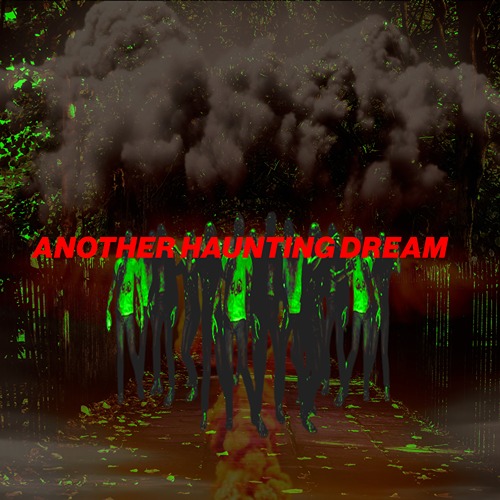
I had this nightmare or dream last night it was a recurring dream of me being in a nuclear bomb explosion and the fallout around that. I already did an Ebook on the last couple I had cos now I had at least six or seven dreams or nightmares but they are more like anxiety dreams. I explained that it was probably from the aeroplanes going past and it sounded like a bomb just got dropped or that’s how I think it sounded or my brain should I say thinks it sounds. I recently finished a zombie game where I got the template online and did my own thing with IE. I made the sprites including the zombies and other stuff in the game, which is why I had zombies in my dream or a zombie  but I’ll leave a link to both the game and Ebook below if you want to check that out it’s all free and on this website. I didn’t read the news article or watch the video but there was an explosion in Oxfordshire apparently it was a gas tank that got hit by lightning and there was a big fireball the thumbnail to the video looked like it was a nuclear explosion which probably is another factor of me having the dream or nightmare but it’s been a while since I had one and was quite scary exactly in parts I was on my edge of the seat in my dream and real uptight and on edge I remember that. 

Mental Release

In the first part, I was in a mental hospital or a prison or it could have been both as it goes one bit to the next like you just fast forward the ads. The television was on and a nuclear explosion had just happened somewhere. I’m not really sure what happened before that but I think the news reporter got munched by a zombie after the nuclear explosion and it panned and stayed on the horizon of a field or whatever the backdrop was. I was then let out of the prison or asylum because of the explosion they said I was let out on good behaviour even though I was causing some sort of ruckus over something that I can’t remember. But I remember thinking I can’t believe they were letting me out but was quick out the door.  I rushed home because of the pandemic and presumably because of the explosion too. As I was making my way home on foot I went down alleys and roads that were best described as the Black Mirror episode where she wakes up and finds she’s the only person to be in existence but there was a bit where she’s walking down the roads and passed houses as you would see in Coronation street or up north new built attached houses. Something happened just before I appeared in my flat in the next bit I remember but it was something that shook me a bit in my dream and happened around the newly built house and was like the Civic Center dream I had and mentioned in the Ebook there’s a whole chapter dedicated to that part of the dream.

Home At Last

The next bit I was in my flat there was some sort of row in my bedroom. I’m still unsure what it was about but it was something major and taking up a lot of my time as I had plans to leave for the town as it might have been said on the news at the asylum or prison to leave your homes and head to safety, I’m not too sure.  Something caused me to leave my flat I think as I said wanted to head to town and get to safety so I walked which took some time and was slow-paced. Also, I was in my flat for some time as I couldn’t leave but I wanted to and had to wait for something but again I’m not sure what. I think I watched TV and got more updates of the explosion and watched normal TV as they told us on the TV we were safe and that nothing is going on even though there was a nuclear explosion live on TV and also a zombie attack or some sort of beast but I think it was a zombie as it looked more like but it wanted blood.

Up The Market

I was by Old Market Street it’s the main point or one of the main points into town coming from the outskirts of Bristol and is a famous street in Bristol it’s well known and not for it’s roughness. I was attacked by a zombie as I made my way into town and also met someone after I got attacked by a zombie and we stole a car because, in the car we were advised to get into a car but that was it and we thought another nuclear explosion was going to happen. Not only that there was some sort of barricade blocking the way to walk and only cars were going past there weren’t that many cars but there were one or two. The car journey didn’t last that long and we ended up going our different ways once we got into the main town part which was outside Debenhams but at the back entrance away from the main street and overlooking a busy road, opposite a busy bus stop and a Beefeater but in my dream the bus stop and Beefeater wasn’t there. It wasn’t busy in my dream either and no one standing on my side of the road even near the main road by Marks & Spensers I was standing at the top of the road so nowhere near there but I could see all the way down.

Wait Your Turn

So there I was outside Debenhams and I saw people on either side of the road. It looked different to how it looked in reality. The road had barriers on both sides, queuing up to leave town. There must have been talk of authorities or some man who took over the town whilst it was in a state and in panic well I think the authorities told us to leave and the man whoever he was, was trying to get everyone to stay why I have no idea but it seemed like a cunning plan he was going to hatch. I didn’t know what was going on as in people queuing to leave Bristol till I saw these queues of people and found out then.  Whilst queuing up we all learned of the man who wanted us to stay in Bristol which we knew we were going to die if we stayed and somehow he was holding us back but this was our actual freedom. Why and how who knows but it was decided we were going to hunt him down and set off to his destination. He may have been a zombie creator whatever it was it was bad enough to go hunt for him down and win back our freedom. Some people were talking of staying if they managed to get hold of this man whoever he was. We then went to look for him, hearing that he had escaped to a theatre so that’s where we headed to and wasn’t much of a walk but seemed longer in the dream. 

The Show Begins

The theatre was cordoned off with wood fencing, but music was blasting from the outside speakers with flood lights that were still on in the day time. The zombie creator or whoever he was stood behind the wooden fencing and behind a wall out of view and we all knew he was there but couldn’t get to him who knows what would have happened but all that could be seen was his shadow. There were two entrances in the front and two as you go in like an old-fashioned cinema entrance or theatre you might still see and a  pink neon lighting and writing in a cool font I was admiring the font with the neon light and there was music playing. It sounded nice at the beginning like cinematic music then it went all wired and hard to hear the music and was like a distorted wired noise it scared some of the people but not everyone. The next bit was away from the theatre it seemed around the corner but there was talk of some people held captive nearby and just as it happened our freedom was awaiting at this location but we were warned it wasn’t pretty or it was going to be just a walk in the park but we were all worried about it and didn’t know where we were going end up, especially with the zombies or whatever they were but we were up for it and wanted to be at the final place with no drama.

Nightmare In The Woods

Next, there was a long trek, for someone gave us the next clue as to what we had to do next, we had to leave Bristol. We trekked to this place or it morphed into woodland it was rather dark in the woods but  was still light out of the woodlands. There were zombies or dead bodies all over the place and covered the forest floor. The whole floor was covered with bodies every last patch of woodland and there was this skeleton zombie thing that looked human at first until I got closer and recognized it wasn’t alive it had a lantern in its hand. Some bodies were still alive but pretended to be dead and was a horrific sight I nearly ran away. The whatever it was with the lantern didn’t detect me and let me pass but was sniffing the next person as it was standing there like it was in a zombie game and I remember quickly walking ahead at a fast pace before it detected me and not to see the fate of the person behind me who knows what happened to them? The creature with the lantern, they were over-seers and looked strong and powerful oh there was also groaning going on coming from the creature and some of the bodies on the floor it was terrifying, I was looking for someone in particular, but then discovered that they were one of the dead bodies on the ground in the woods so I had to get out of there as soon as I could and that’s what I did I got out safe and I think there were loads of undead creatures by that point and chased me out of the woods into the daylight again as that felt like it was the safe zone again.

The Chase Is On

During this last bit of the dream, I ran into a building, it was a side-view like a long mobile builder’s hut, it had windows but at the same time it was a train maybe it was part of an old railway line in Bristol onwards to Bath but at first it looked like a hut. I was by the window so I opened it oh there was also some unhidden danger that I faced so I opened the window to get a better look and saw a crowd and a man, not the person or the unhidden danger but they were all running away down the hill as it looked mountain. I had my head hanging out of the window and they were running away from me because I was shouting and waving for them to go there was also this weird eclipse that happened too shortly before I chased people away and also a quick glimpse of some dragon King Kong I don’t know what it was but it looked a lot like that and then I then woke up once again relived it was only a dream especially the woodland bit I was shook it felt like I seen it all before but a different dream.
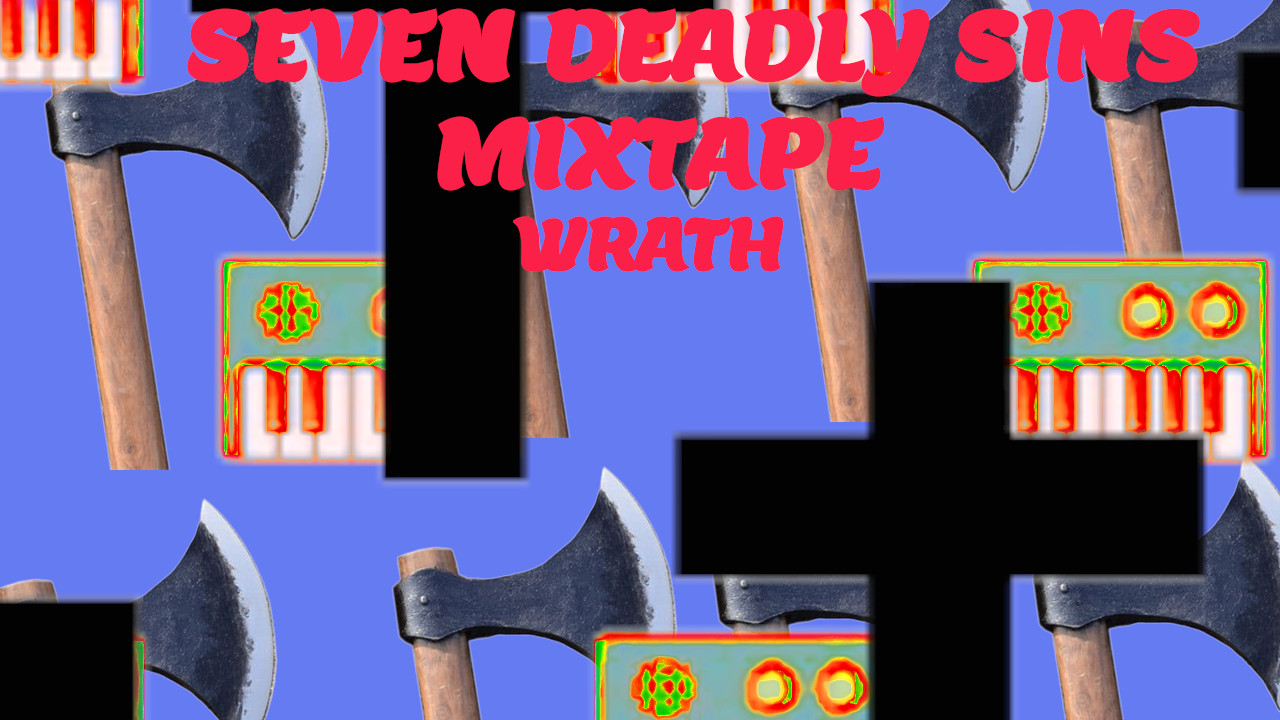
Bandcamp News – New Mixtape Release; Seven Deadly Syns – Wrath

BANDCAMP NEWS

17/09/2023 - New Mixtape; Seven Deadly Syns Mixtape - Wrath

This is five of seven of my mixtape series Seven Deadly Syns pronounced the normal way as in sin and is all synthy instrumentals related to the sin and there are seven in total. I enjoy putting the mixtape and the visual together and I made all the beats as well and are just some of my now unreleased tracks that were on Spotify etc. but I swapped artist names so they are now all unreleased dating back to around 2018 when I started remaking music and playing the keyboard. This one is Wrath so it’s angry, moody, violent and dark probably the darkest of the seven mixtapes and my favourite as I like my music dark and moody with thick basses and synths and I hope you do too.

Wrath or rage, is an intense emotional state involving a strong uncomfortable and non-cooperative response to a perceived provocation, hurt or threat. A person experiencing anger will often experience physical effects, such as increased heart rate, elevated blood pressure, and increased levels of adrenaline and noradrenaline. Some view anger as an emotion which triggers part of the fight or flight response. Anger becomes the predominant feeling behaviorally, cognitively, and physiologically when a person makes the conscious choice to take action to immediately stop the threatening behaviour of another outside force.

Anger can have many physical and mental consequences. The external expression of anger can be found in facial expressions, body language, physiological responses, and at times public acts of aggression. Facial expressions can range from inward angling of the eyebrows to a full frown. While most of those who experience anger explain its arousal as a result of “what has happened to them”, psychologists point out that an angry person can very well be mistaken because anger causes a loss in self-monitoring capacity and objective observability.

Modern psychologists view anger as a normal, natural, and mature emotion experienced by virtually all humans at times, and as something that has functional value for survival. Uncontrolled anger can negatively affect personal or social well-being and negatively impact those around them. While many philosophers and writers have warned against the spontaneous and uncontrolled fits of anger, there has been disagreement over the intrinsic value of anger. The issue of dealing with anger has been written about since the times of the earliest philosophers, but modern psychologists, in contrast to earlier writers, have also pointed out the possible harmful effects of suppressing anger. 

Judaism

Main article: Anger in Judaism
In Judaism, anger is a negative trait. In the Book of Genesis, Jacob condemned the anger that had arisen in his sons Simon and Levi: “Cursed be their anger, for it was fierce; and their wrath, for it was cruel.”

Restraining oneself from anger is seen as noble and desirable, as Ethics of the Fathers states:

Ben Zoma said:

Who is strong? He who subdues his evil inclination, as it is stated,

“He who is slow to anger is better than a strong man, and he who masters his passions is better than one who conquers a city” (Proverbs 16:32.)

Maimonides rules that one who becomes angry is as though that person had worshipped idols. Rabbi Shneur Zalman of Liadi explains that the parallel between anger and idol worship is that by becoming angry, one shows a disregard for Divine Providence – whatever had caused the anger was ultimately ordained from Above – and that through coming to anger one thereby denies the hand of God in one’s life.

In its section dealing with ethical traits a person should adopt, the Kitzur Shulchan Aruch states: “Anger is also a very evil trait and it should be avoided at all costs. You should train yourself not to become angry even if you have a good reason to be angry.”

In modern writing, Rabbi Harold Kushner finds no grounds for anger toward God because “our misfortunes are none of His doing.” In contrast to Kushner’s reading of the Bible, David Blumenthal finds an “abusing God” whose “sometimes evil” actions evoke vigorous protest, but without severing the protester’s relationship with God.

Christianity

Both Catholic and Protestant writers have addressed anger in different perspectives.

Catholic

The Seven Deadly Sins and the Four Last Things, by Hieronymus Bosch (1485). “Wrath” is depicted at the bottom in a series of circular images. Below the image is the Latin inscription Cave Cave Deus Videt (“Beware, Beware, God is Watching”).

Angel with Temperance and Humility virtues versus Devil with Rage and Wrath sins. A fresco from the 1717 Saint Nicholas Orthodox Church in Cukovets, Pernik Province, Bulgaria
Wrath is one of the Seven Deadly Sins in Catholicism; and yet the Catechism of the Catholic Church states (canons 1772 and 1773) that anger is among the passions, and that “in the passions, as movements of the sensitive appetite, there is neither good nor evil”. The neutral act of anger becomes the sin of wrath when it’s directed against an innocent person, when it’s unduly unbending or long-lasting, or when it desires excessive punishment. “If anger reaches the point of a deliberate desire to kill or seriously wound a neighbour, it is gravely against charity; it is a mortal sin” (CCC 2302). Hatred is the sin of desiring that someone else may suffer misfortune or evil and is a mortal sin when one desires grave harm (CCC 2302-03).

Medieval Christianity vigorously denounced wrath as one of the seven cardinal, or deadly sins, but some Christian writers at times regarded the anger caused by injustice as having some value. Saint Basil viewed anger as a “reprehensible temporary madness.” Joseph F. Delany in the Catholic Encyclopedia (1914) defines anger as “the desire of vengeance” and states that a reasonable vengeance and passion are ethical and praiseworthy. Vengeance is sinful when it exceeds its limits in which case it becomes opposed to justice and charity. For example, “vengeance upon one who has not deserved it, or to a greater extent than it has been deserved, or in conflict with the dispositions of law, or from an improper motive” are all sinful. An unduly vehement vengeance is considered a venial sin unless it seriously goes counter to the love of God or of one’s neighbour.

A more positive view of anger is espoused by Roman Catholic pastoral theologian Henri J.M. Nouwen. Father Nouwen points to the spiritual benefits of anger toward God as found in both the Old Testament and New Testament of the Bible. In the Bible, says Father Nouwen, “It is clear that only by expressing our anger and hatred directly to God will we come to know the fullness of both his love and our freedom”.

Georges Bernanos illustrates Nouwen’s position in his novel The Diary of a Country Priest. The countess gave birth to the son she had long wanted, but the child died. She was fiercely angry. When the priest called, the countess vented her anger toward her daughter and husband, then at the priest who responded gently, “Open your heart to [God]”. The countess rejoined, “I’ve ceased to bother about God. When you’ve forced me to admit that I hate Him, will you be any better off?” The priest continued, “You no longer hate Him. Hate is indifference and contempt. Now, at last, you’re face to face with Him … Shake your fist at Him, spit in His face, scourge Him.” The countess did what the priest counselled. By confessing her hate, she was enabled to say, “All’s well.”

Protestant

Saul attacks David (who had been playing music to help Saul feel better), 1860 woodcut by Julius Schnorr von Karolsfeld, a Lutheran
Everyone experiences anger, Andrew D. Lester observes, and furthermore, anger can serve as “a spiritual friend, a spiritual guide, and a spiritual ally”. Denying and suppressing anger is contrary to St. Paul’s admonition in his Epistle to the Ephesians 4:26. When anger toward God is denied and suppressed, it interferes with an individual’s relationship with God. Expressing one’s anger toward God can deepen the relationship. C. FitzSimons Allison holds that “we worship God by expressing our honest anger at him”.

Biblical scholar Leonard Pine concludes from his studies in the Book of Habakkuk that “far from being a sin, proper remonstration with God is the activity of a healthy faith relationship with Him”.[141] Other biblical examples of anger toward God include the following:

Moses was angry with God for mistreating his people: “Lord, why have you mistreated [lit. done evil to] this people?” (Book of Exodus 5:22).

Naomi was angry with God after the death of her husband and two sons: “The Almighty has dealt bitterly with me. The Almighty has brought calamity upon me” (Book of Ruth 1:20–21 abr).
Elijah was angry with God after the son of the widow died: “O Lord my God, have you brought calamity even upon the widow with whom I am staying, by killing her son?” (1 Kings 17:20).
Job was angry with God: “You have turned cruel to me; with the might of your hand you persecute me” (Book of Job 30:21).
Jeremiah was angry with God for deceiving his people: “Ah, Lord God, how utterly you have deceived this people and Jerusalem” (Book of Jeremiah 4:10).

Hinduism

In Hinduism, anger is equated with sorrow as a form of unrequited desire. The objects of anger are perceived as a hindrance to the gratification of the desires of the angry person. Alternatively if one thinks one is superior, the result is grief. Anger is considered to be packed with more evil power than desire. In the Bhagavad Gita, Krishna regards greed, anger, and lust as signs of ignorance that lead to perpetual bondage. As for the agitations of the bickering mind, they are divided into two divisions. The first is called avirodha-prīti, or unrestricted attachment, and the other is called virodha-yukta-krodha, anger arising from frustration. Adherence to the philosophy of the Māyāvādīs, belief in the fruitive results of the karma-vādīs, and belief in plans based on materialistic desires are called avirodha-prīti.

Jñānīs, karmīs and materialistic planmakers generally attract the attention of conditioned souls, but when the materialists cannot fulfil their plans and when their devices are frustrated, they become angry. Frustration of material desires produces anger.

Buddhism
Anger is defined in Buddhism as: “being unable to bear the object, or the intention to cause harm to the object”. Anger is seen as aversion with a stronger exaggeration, and is listed as one of the five hindrances. Buddhist monks, such as Dalai Lama, the spiritual leader of Tibetans in exile, sometimes get angry. Most often a spiritual person is aware of the emotion and the way it can be handled. Thus, in response to the question: “Is any anger acceptable in Buddhism?’ the Dalai Lama answered.

Buddhism, in general, teaches that anger is a destructive emotion and although anger might have some positive effects in terms of survival or moral outrage, I do not accept that anger of any kind is a virtuous emotion or aggression as constructive behaviour. The Gautama Buddha has taught that there are three basic kleshas at the root of samsara (bondage, illusion) and the vicious cycle of rebirth. These are greed, hatred, and delusion—also translatable as attachment, anger, and ignorance. They bring us confusion and misery rather than peace, happiness, and fulfilment. It is in our own self-interest to purify and transform them.

Buddhist scholar and author Geshe Kelsang Gyatso has also explained Buddha’s teaching on the spiritual imperative to identify anger and overcome it by transforming difficulties;

When things go wrong in our lives and we encounter difficult situations, we tend to regard the situation itself as our problem, but in reality, whatever problems we experience come from the side of the mind. If we responded to difficult situations with a positive or peaceful mind they would not be problems for us. Eventually, we might even regard them as challenges or opportunities for growth and development. Problems arise only if we respond to difficulties with a negative state of mind. Therefore if we want to be free from problems, we must transform our minds.

The Buddha himself on anger

An angry person is ugly & sleeps poorly. Gaining a profit, he turns it into a loss, having done damage with word & deed. A person overwhelmed with anger destroys his wealth. Maddened with anger, he destroys his status. Relatives, friends, & colleagues avoid him. Anger brings loss. Anger inflames the mind. He doesn’t realize that his danger is born from within. An angry person doesn’t know his own benefit. An angry person doesn’t see the Dharma. A man conquered by anger is in a mass of darkness. He takes pleasure in bad deeds as if they were good, but later, when his anger is gone, he suffers as if burned with fire. He is spoiled, blotted out, like fire enveloped in smoke. When anger spreads, when a man becomes angry, he has no shame, no fear of evil, and is not respectful in speech. For a person overcome with anger, nothing gives light.

The colour of Wrath is red and punishment in hell is to be dismemberded. 


Bandcamp News – New Mixtape Release; Seven Deadly Syns – Sloth

September 29, 2023

BANDCAMP NEWS

15/09/2023 - New Mixtape; Seven Deadly Syns Mixtape - Sloth

This is four of seven of my Seven Deadly Syns but pronounced sin in the normal way of saying it as in “SINNER.” I must say this was the easiest to do and is more slower and lazy track you would listen to before you go to bed at night or before you take a nap or just relax on Sunday or any day for that matter. As always I enjoyed putting it together and making the visuals, covers and thumbnails. I forgot to say but I bought some new effects for the software I’m using it’s actually inside my DAW (Digital Work Station)  FL Studio I put my own stamp on them and I’m learning how to customize it more but there’s progression. I don’t think I said but I have something lined up to go with the music and visuals but I have to finish all seven first before I publish it I also have to keep testing it which is a pain but we are getting there eventually but what a headache to figure out.

Sloth is one of the seven deadly sins in Catholic teachings. It is the most difficult sin to define and credit as sin since it refers to an assortment of ideas, dating from antiquity and including mental, spiritual, pathological, and physical states.[ One definition is a habitual disinclination to exertion or laziness.

Views concerning the virtue of work to support society and further God’s plan suggest that through inactivity, one invites sin: “For Satan finds some mischief still for idle hands to do.” (“Against Idleness and Mischief” by Isaac Watts).


The word “sloth” is a translation of the Latin term acedia (Middle English, acciditties) and means “without care”. Spiritually, acedia first referred to an affliction to women, religious persons, wherein they became indifferent to their duties and obligations to God. Mentally, acedia has a number of distinctive components of which the most important is affectlessness, a lack of any feeling about self or others, a mind state that gives rise to boredom, rancour, apathy, and a passive, inert, or sluggish mentation. Physically, acedia is fundamentally a cessation of motion and an indifference to work; it finds expression in [sloth can also be referred to as Laziness], idleness, and indolence. Two commentators consider the most accurate translation of acedia to be “self-pity,” for it “conveys both the melancholy of the condition and self-centeredness upon which it is founded.”

Orthodoxy

In the Philokalia, the word dejection is used instead of sloth, for the person who falls into dejection will lose interest in life.

Others

Sloth has also been defined as a failure to do things that one should do, though the understanding of the sin in antiquity was that this laziness or lack of work was simply a symptom of the vice of apathy or indifference, particularly an apathy or boredom with God. Concurrently, this apathy can be seen as an inadequate amount of love.

Emotionally and cognitively, the evil of acedia finds expression in a lack of any feeling for the world, for the people in it, or for the self. Acedia takes form as an alienation of the sentient self first from the world and then from itself. Although the most profound versions of this condition are found in a withdrawal from all forms of participation in or care for others or oneself, a lesser but more noisome element was also noted by theologians. From tristitia, asserted Gregory the Great, “there arise malice, rancour, cowardice, [and] despair…” Geoffrey Chaucer, too, dealt with this attribute of acedia, counting the characteristics of the sin to include despair, somnolence, idleness, tardiness, negligence, indolence, and wrawnesse, the last variously translated as “anger” or better as “peevishness”. For Chaucer, human sin consists of languishing and holding back, refusing to undertake works of goodness because, he/she tells him/herself, the circumstances surrounding the establishment of good are too grievous and too difficult to suffer. Acedia in Chaucer’s view is thus the enemy of every source and motive for work.

Sloth not only subverts the livelihood of the body, taking no care for its day-to-day provisions but also slows down the mind, halting its attention to matters of great importance. Sloth hinders man in his righteous undertakings and becomes a path to rui

According to Peter Binsfeld’s Binsfeld’s Classification of Demons, Belphegor is the chief demon of the sin Sloth.

Christian author and Clinical Psychologist Dr. William Backus has pointed out the similarities between sloth and depression. “Depression involves aversion to effort, and the moral danger of sloth lies in this characteristic. The work involved in exercising one’s will to make moral and spiritual decisions seems particularly undesirable and demanding. Thus the slothful person drifts along in habits of sin, convinced that he has no willpower and aided in this claim by those who persist in seeking only biological and environmental causes and medical remedies for sloth.”


The colour of sloth is light blue and the punishment for committing this sin is to be put in a snake pit.